
Renaissance artists depicted mostly biblical narratives and scenes, but they remained human with their weaknesses. There were enough trials, stale bread and exiles in their fates, which are interesting to learn about, but which often remain unknown. Well, let’s raise the curtain.
The artist was born in Florence in the family of a tile and brick master. His real name – Andrea di Michele di Francesco de’ Cioni. Very little is known about his childhood. It was first mentioned in documents in 1452 in connection with the accidental killing of an adult during a game. Andrea was acquitted.
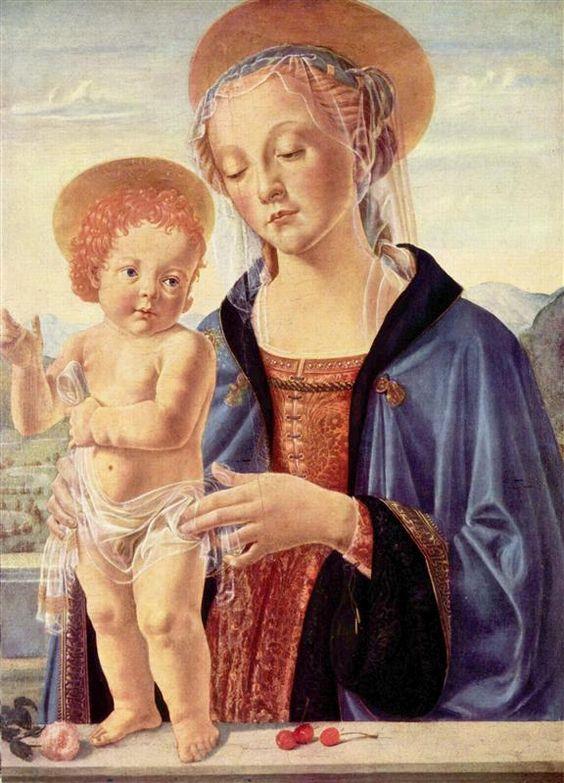
Already in 1457, Andrea received the right to call himself a master. He was engaged in the production of buttons for the clothes of priests, various church utensils and was quite a famous jeweler at that time. From 1463 to 1487, Verrocchio also worked on various sculptural compositions, in particular, in 1476 he created a bronze statue of David. Together with Donatello, he made a Holy water font with Medicean heraldic elements for the Florentine church. At the same time, Verrocchio became interested in painting. Verrocchio’s successes as a painter are not very significant. Quite often, he commissioned some elements of the paintings to his students — Leonardo da Vinci, Francesco di Giovanni Botticini, Lorenzo di Credi and others. Among the works of Verrocchio, the most famous is «Madonna and Child» (1470).
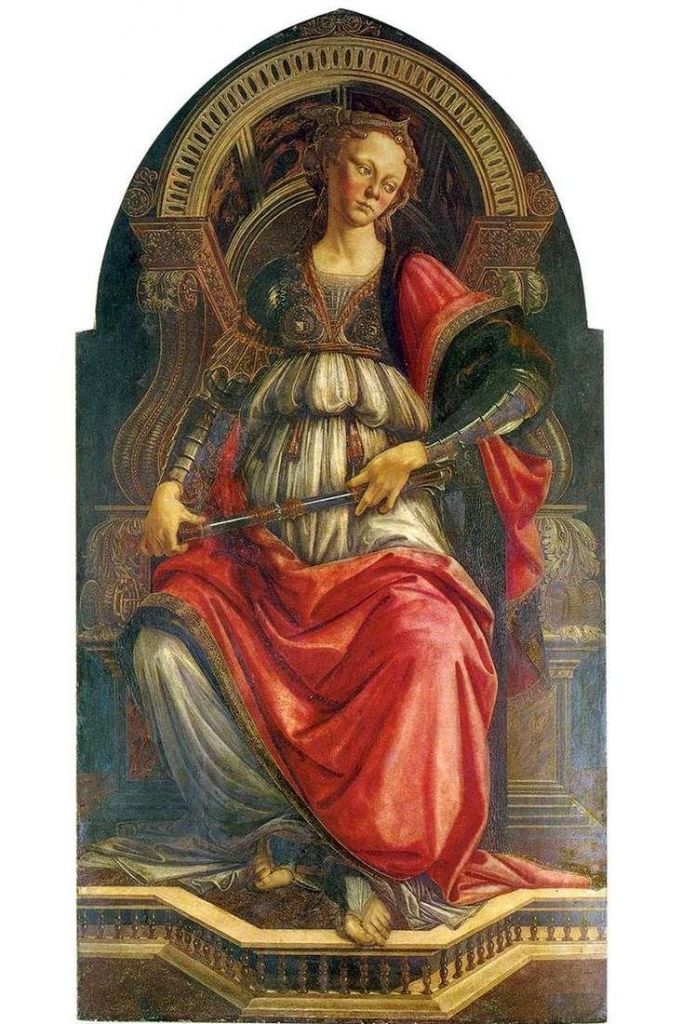
Although he is now one of the most famous Florentine painters of the late 15th century, Botticelli was forgotten for almost three centuries, while in the middle of the 19th century interest in his work did not revive. Sandro Botticelli was the youngest son in a craftsman’s family. He studied for three years with the famous Florentine painter Filippo Lippi, and then continued his studies with the already mentioned Andrea Verrocchio. In 1470, the artist’s first painting was created – «Allegory of Fortitude». According to the ideas characteristic of Florence, Botticelli painted a figure embodying moral strength and confidence. Its contours are clearly outlined, highlighting clearly plastic volumes; the clothes fall calmly, forming broad folds like those we can see in Verrocchio’s sculpture.
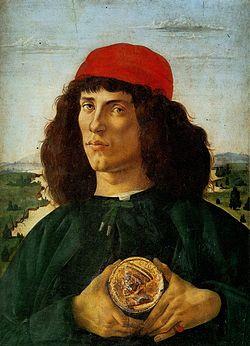
In the mid-1470s, Sandro Botticelli turned to the portrait genre of art. During this period, «Portrait of a Man with a Medal of Cosimo the Elder» appears. It is not known who this young man was. There is an opinion that this is a self-portrait.
In 1482, Pope Sixtus IV asked Botticelli to help design the Sistine Chapel. Then Sandro Botticelli executed three biblical frescoes. After that, he returned to Florence and created the main masterpiece there – «Spring» («Primavera») (1482), which depicts the kingdom of Venus. In the late 1470s and early 1480s, Botticelli works on illustrations for «The Divine Comedy» by Dante Alighieri. Several of this series of paintings have survived to our time, among them «The Map of Hell» (La Mappa dell’Inferno).
In 1490-1500, Botticelli came under the influence of the teachings of the Dominican friar Girolamo Savonarola, who criticized the church order of that time. Absorbed by the ideas of asceticism and penance, Botticelli began to use darker and more restrained colors.
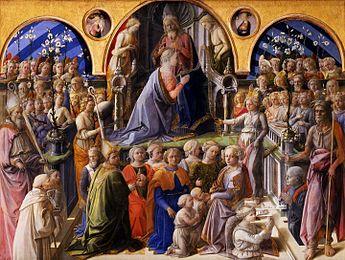
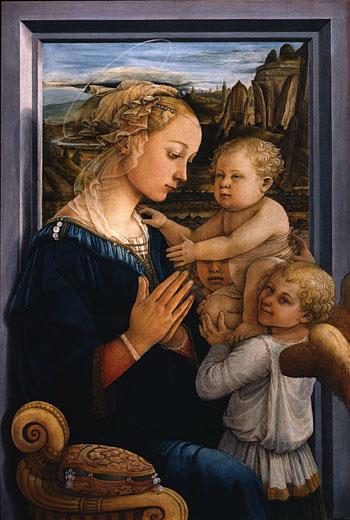
Florentine painter, Carmelite priest, teacher of Botticelli and owner of one of the most adventurous biographies among Renaissance artists. Fra Filippo Lippi (also known as Lippo Lippi) was an orphan from early childhood, so he was raised by his aunt. She was not rich and could not feed him, so the future painter lived and studied in a monastery from the age of eight. The monks were good teachers, but they recognized that Filippo was bad in the humanities and not at all in the exact sciences. Only in drawing lessons this absent-minded boy was collected and attentive. And the monks quickly understood: if they raise him to be a talented painter, then there will be no need to pay for church paintings to other people. Since then, instead of spending time on grammar and geometry, Filippo spent his time in the Brancacci Chapel, which was painted by Masaccio at that time. Already in 1426, Filippo became the right hand of the abbot of the monastery in Siena. The first mentions of him as a painter appear in 1430. The praise affected Filippo so much that he left the monastery and chose the life of a free artist. And so Fra Filippo (from the Italian «fratello» – brother) «went for a swim alone». This adventurer even spent a year and a half in Africa as a slave, but he was released thanks to the portrait of his owner, which impressed him so much. Returning to his homeland, he paints the painting «Coronation of Mary». He made some changes in the interpretation of the plot of the coronation of the Mother of God. In his painting, Mary is crowned not by Jesus Christ, but by God the Father, while Mary kneels before God. But by his nature, Fra Filippo was a secular man «weak» to women and wine. It bothered Filippo Lippi and he could forget about his affairs when he fell in love with a certain woman.
In the period from 1447 to 1456, Fra Filippo Lippi painted paintings in which the artist’s style was formed. Among them is the «Madonna with the Child and Two Angels» – a work that reflects the maximum vitality, which is especially noticeable in the image of Madonna. The Byzantine flatness in the elongated hands and face has disappeared. Maria looks like a real woman and mother who can be found on the streets of Florence. Therefore, not only the life of Fra Filippo Lippi contradicted the church canons, but also his work.
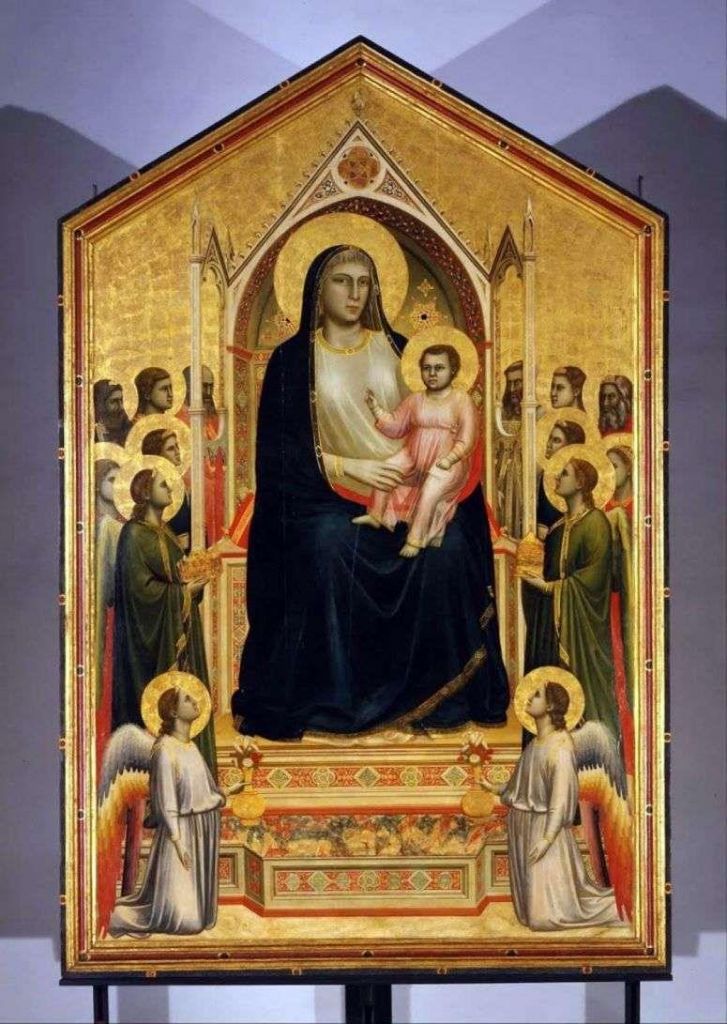
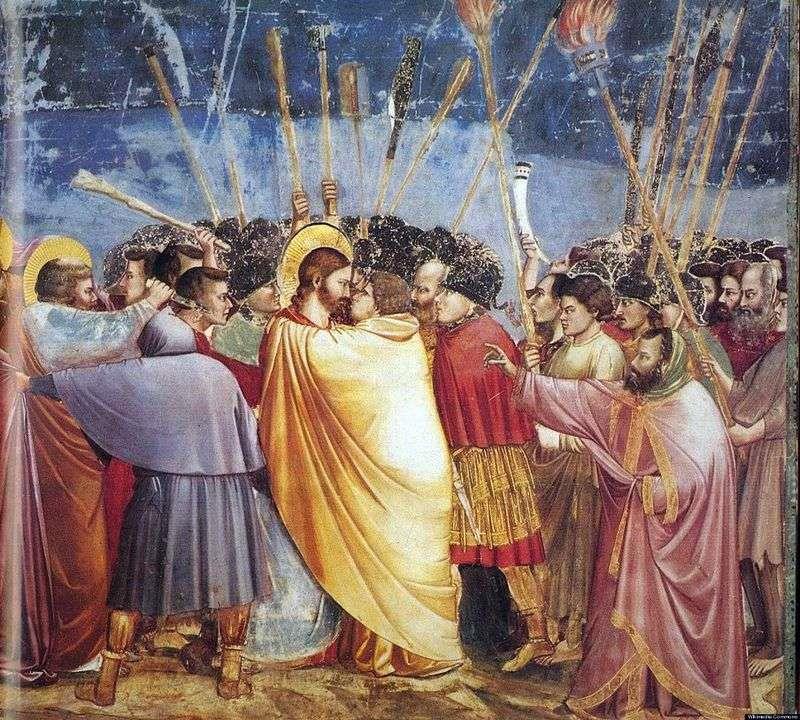
Despite the fact that there are many stories and legends about Giotto and his life, very few of them can be confirmed as fact. In the works of the historian Giorgio Vasari, it is stated that the painter was born in the family of a farmer near Florence. He was noticed in the field by the then famous painter Cimabue, when Giotto was painting something on a stone. Instead, in the anonymous comments of the «Divine Comedy», the author claims that the boy was sent to the weaver’s workshop, but Giotto escaped from the craftsman to the artist’s workshop. In 1303-1306, Giotto worked in Padua. There, the painter fulfilled the order of the local rich man Enrico degli Scrovegni – he decorated his family chapel with frescoes depicting scenes from the life of Jesus Christ and the Virgin Mary. The frescoes of the Scrovegni chapel are called the best creations of the artist. At this time, Giotto had already finally formed his own creative methods and style, and the frescoes in the chapel have been preserved very well, so they are a valuable find for art historians. At the zenith of fame, the artist returned to Florence. There he painted the walls of the two chapels of the Basilica of Santa Croce, and in 1310 he created for the Church of All Saints (The chiesa di San Salvatore di Ognissanti) the famous painting «Ognissanti Madonna», which depicts the Virgin Mary with the Christ Child surrounded by Angels and Saints. Giotto’s interpretation of the image of Mary turned out to be fresher and brighter compared to the classic religious images of the Middle Ages. You can also notice subtle psychologism in his paintings, which can be seen, for example, in the painting «The Kiss of Judas» (1306). In it, despite the large number of people in the picture, the figures of Jesus and Judas attract all the attention. The closeness of these opposite characters and the cloak of Judas, which seems to absorb the figure of Jesus, contain the entire conflict and the entire idea of the painting.
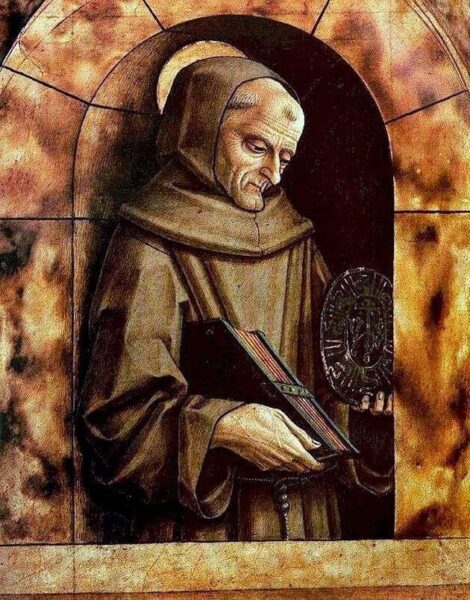
As you know, Carlo Crivelli was born in the family of the artist Jacob Crivelli in Venice. His studying was probably under the guidance of his father. The first document about the artist has a scandalous reputation and is an evidence to the powerful passions and passionate feelings of which he was capable. The fact is that Carlo fell in love with the sailor’s wife and kidnapped her – by this act, he violated the holy principles of married life. The love affair ended for the young artist with a court sentence of six months in prison and a monetary fine (as if love is treated by imprisonment). After these adventures, he was forced to leave Venice to escape human condemnation. But in 1468 he returned to Italy and worked in provincial cities.
«Saint Bernardino of Siena» belongs to the period of the artist’s early work. The image of the Saint is somewhat caricatured. It can be seen that when creating his paintings for the altar, Crivelli took great pleasure in the unusual methods which sometimes seem strange. The authorship of the paintings on this altar has often been questioned, suggesting that Crivelli’s younger brother Vittorio participated in their creation. However, they are so superior to the works of his brother that they cannot be counted among the works of Vittorio Crivelli.
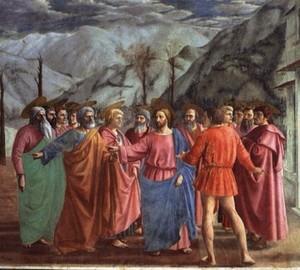
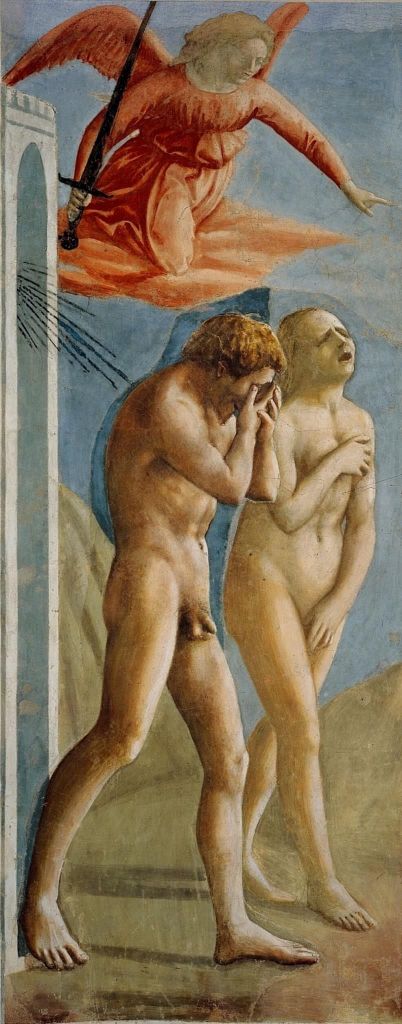
Masaccio lived a very short life, so there are few biographical records about the artist. He received the nickname for his inattention and indifference (from Italian it can be translated as «the one who misses») to things that were beyond art. The artist became an orphan at the age of five when his father died. It is assumed that Masaccio’s teachers were Donatello and Brunelleschi. Masaccio moved to Florence early and after receiving the title of master of painting, he began working in a workshop. The crown of Masaccio’s creativity is called the frescoes of the Brancacci Chapel – part of the Church of Santa Maria del Carmine. Masolino da Panicale began to paint the chapel, Masaccio continued it, and Filippino Lippi (son of Filippo Lippi) finished it.
Two frescoes are characteristic: «The Tribute Money» (also «Miracle with a Statir») and «Expulsion from the Garden of Eden». In the first, the author retells a biblical story about a tax collector who decided to collect a toll from Jesus and the apostles. Jesus ordered the apostle Peter to catch a fish from the lake and take a denarius from its mouth. Petro really found a coin in the fish’s mouth, which he gave to the taxman. In «Expulsion from the Garden of Eden», the artist solved the acute problem of correctly conveying the structure of the naked human body. Not only is the actual depiction of Adam and Eve anatomically correct, but their tragic expressions of despair are visible on their faces; body poses are very natural and plastic unlike traditional medieval static poses.
Leonardo da Vinci was born near the town of Vinci, near Florence. His father is a wealthy notary, his mother is a peasant. Leonardo spent only the first years with his mother, because when his father married a rich woman, he took him to live with him. It is believed that Leonardo, lost contact with his mother, tried to reproduce her image in his masterpieces all his life. Leonardo became interested in painting at a young age: at the age of 15, he studied in the workshop of the Italian sculptor and painter Andrea del Verrocchio.
Leonardo traveled for many years in Italy, engaged in mathematics and engineering. He made dozens of inventions, the drawings of which were found only after his death. In particular, Leonardo da Vinci invented a parachute, a prototype for a machine gun and a diving suit.
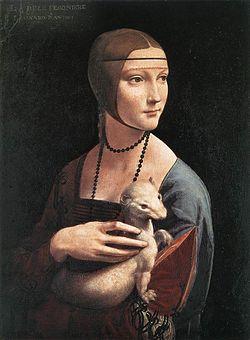
At the age of 24, Leonardo and three other young men were brought to trial on an anonymous charge of sodomy, but they were acquitted. Very little is known about his life after this event, but he probably had his own workshop in Florence from 1476 to 1481. In 1481, when Leonardo was 29 years old, the monastery of San Donato a Scopeto ordered from him a large altarpiece «Adoration of the Magi». This painting was not finished. By the way, Leonardo da Vinci is known for his trait of not finishing his projects. «Lady with an Ermine» (1489-1490) belongs to one of the four most famous portraits of women by Leonardo da Vinci. The painting probably depicts one of Duke Sforza’s mistresses, Cecilia Gallerani. The ermine was chosen for the picture not by chance – for its white fur, the ermine was considered a symbol of purity and chastity. According to legend, if its skin become dirty and lost its white color, the ermine will die.
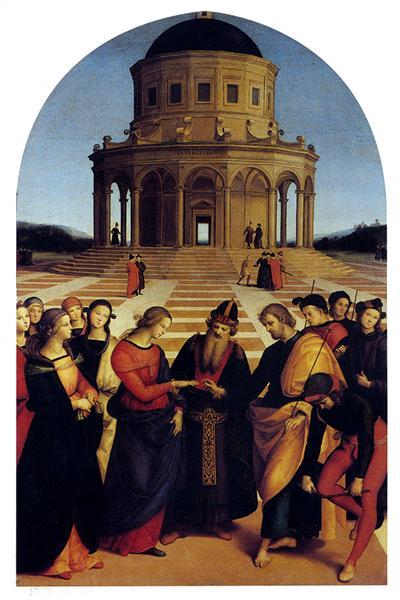
Raphael Santi was born in the family of the painter and decorator Giovanni Santi in the city of Urbino. His father was under the patronage of the Dukes of Urbino and worked as their court painter. The young Raphael helped fulfill numerous orders of the Duke of Montefeltro. Soon his father realized that his son’s talent exceeded his own, he sent him to study in the city of Perugia with the famous master Pietro Perugino (1446-1523). However, the young man did not want to fulfill his father’s will. Only after his death in 1496 Raphael arrive in Perugia. Three years later, the seventeen-year-old painter was recognized as a mature master. In 1503, taking advantage of the teacher’s absence, Raphael fulfilled a private order for the family chapel painting. The painting «The Marriage of the Virgin» (1504) shows an experienced hand and achievements that were equal to Perugino’s skills.
The plot of the painting is taken from Christian legends. When Maria turned fourteen years old, the suitors for her hand were given a branch. The one with whom it blossomed was to become her husband. The painting shows the moment when Joseph puts on Mary’s ring with a blossoming branch.
The following year, the desire for improvement brings Raphael to Florence. The young painter got acquainted with the work of Leonardo da Vinci and Michelangelo and realized that he had not yet seen true great art.
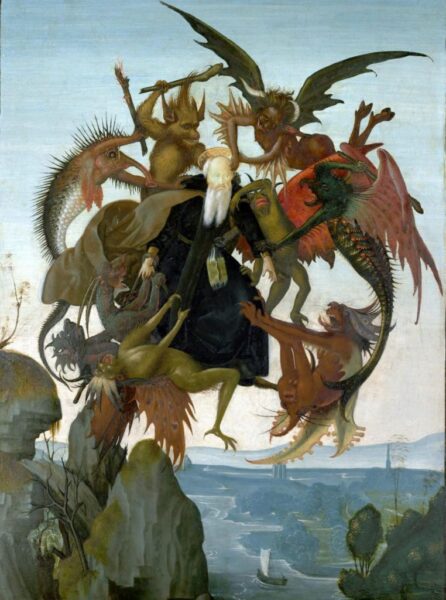
The future genius was born on the territory of Tuscany in the small village of Caprese in the family of a bankrupt aristocrat. The mother died when the boy was six years old. Unable to raise his children on his own, Ludovico Buonarroti was forced to give his son to a nanny. Fortunately, the family to which he was given was loving and treated him well. He acquired skills for sculpture and sculpting sooner than reading or writing. Soon his father remarried, it was decided to send the boy to the school of Francesco Galatea da Urbino. The studyng was very slow and the young artist spent most of his time redrawing icons and frescoes. Realizing that the boy’s studies would not bring results, his father gave Michelangelo to the workshop of Domenico Ghirlandaio. Here he got acquainted with basic art materials and techniques. «The Torment of Saint Anthony» (1487-1488) characterizes the early period of the artist’s work. The painting shows a well-known medieval plot in which Saint Anthony is attacked by demons in the desert and tries to resist their temptations. This painting focuses on the moment when Saint Anthony, who usually moved with the support of angels, falls into a devilish ambush.
Titian Vecellio was born into a noble family and took his first steps in art in the workshop of the mosaicist Sebastiano Zucatto. After that, he studied with masters Giovanni Bellini, Gentile Bellini, Giorgione. From 1517 he held the position of official painter of Venice and its republic. His clients were Charles V, Philip II of Spain, Pope Paul III, the rulers of Mantua, Ferrara, Urbino and other equally famous personalities. If you place all of his paintings in order of appearance, you can trace the path of the artist’s awareness of this world. In early paintings, for example, prevails the joy, and later – dramatic collisions. A distinctive feature of Titian’s late paintings is their subtlest colorful chromaticism. The master builds a color scheme subordinate to a muted golden tone on subtle shades of brown, blue-steel, pink-red, pale green. Titian’s late paintings shimmer with many halftones and are characterized by lightness. The artist’s painting style acquires exceptional freedom. You can read more about famous paintings here.
In fact, the list of Renaissance artists far exceeds ours. And the stories about Renaissance art are inexhaustible. If you are interested in learning more, we recommend our art lectures.
Make it nice for your relatives and friends – order a gift certificate for art master classes or lectures of the Lihtaryk art studio and they will find for them one more favorite place where to go in Kyiv.
Master classes are available online and offline.
У меня синдром Стендаля сегодня. Утром ходили в Падуанский баптистерий. Смотрели фрески Менабуя. А после обеда у нас было посещение каппелы Скровеньи. Теперь я понимаю , что сделал Джотто для мира. Очень меня все это впечатлило в живую. Привет передала. Мир прекрасен. Падуя очень понравилась:) спасибо за лекции Света!
Lily Golovchak
Our location


