
The Renaissance – is about ideals, about the glorification of Antiquity, but it is also about ancestral secrets and riddles on the paintings. It is about the elusive sfumato, thanks to which we are so fascinated by the paintings of this period. It is about the history of mankind. So it’s time to talk about the most famous examples of Renaissance Artwork.
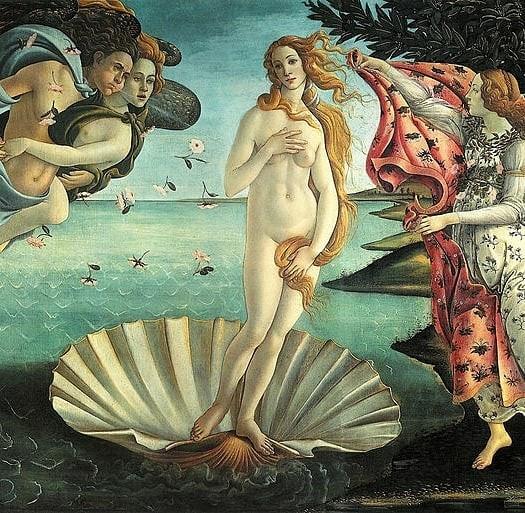
Let’s imagine that we are in the Uffizi Gallery in Italy and we are looking at the painting «The Birth of Venus» by Botticelli (1445-1510). This is, of course, one of the most iconic paintings in the history of Western art. Its popularity lies not only in the size of the canvas or its antiquity, but also in its originality. The fact is that she goes beyond the cultural context of her time – before the appearance of this painting, only the great mother of Eve – a biblical character – could be seen naked on paintings. But here Botticelli depicted Venus – the ancient goddess of love. She was born of the sea and seems to be driven by the winds of Zephyr, who is depicted in human form on the left. The goddess herself is standing on a shell, or rather almost standing – she takes a graceful step to the shore. And when she comes out on it, she will be met by a maid to cover the nudity of Venus. The winds of Zephyr are intertwined in an impossible way. When we look at Renaissance paintings, we usually expect to see naturalism: bodies that are like real ones, and necessarily in real space. But Botticelli shows us something completely different. Some art historians believe that Botticelli turned to ancient Greek paintings as the source of this painting. In this case, the only examples of figures that Botticelli could find that belonged to ancient Greek culture were vase paintings in which the figures are depicted in isolation. In this painting by Botticelli, all the figures are forward, arranged linearly and in one plane, but they are located in isolation. So this style of painting is similar to linear paintings on vases.
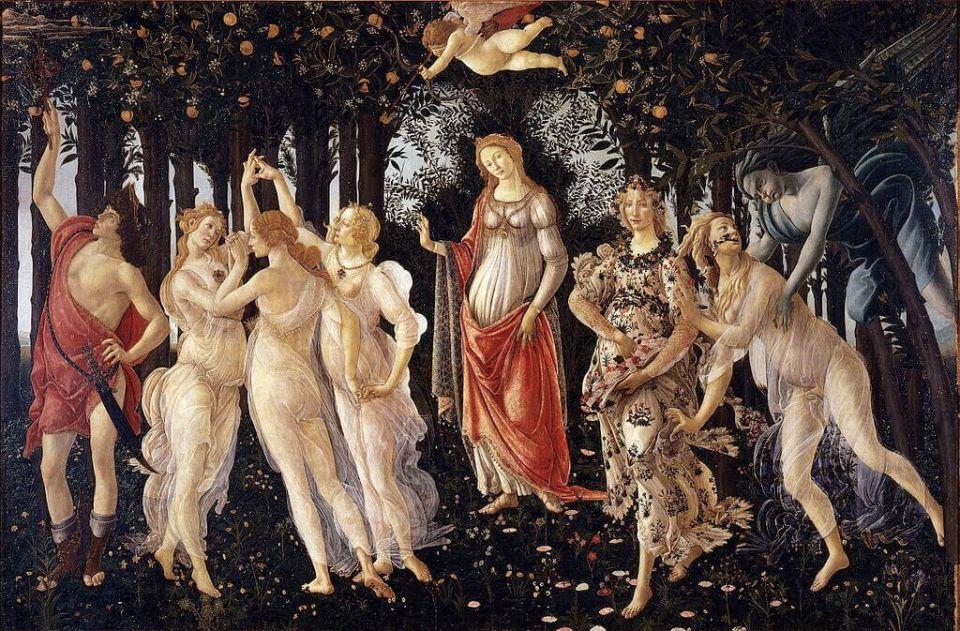
In the center of this painting we see Venus in her sacred grove, she is looking straight at us. The trees near her diverge to show the sky, so behind her a kind of semicircle is formed – a nimbus. This nimbus resembles a half-dome, which is characteristic of temple architecture. During the Renaissance, we can mostly see the Blessed virgin Mary in this style in the temple. But Botticelli followed the trends of the Renaissance, so instead of the Mother of God, the goddess of love and beauty becomes the main one for him. On the left are three graces symbolizing beauty, modesty and love. Above is Amur, who is ready to shoot one of the graces. Everyone knows that this unbearable boy is especially active in the spring, so he wildly shoots his arrows left and right without even looking at whom he is going to hit. Love is blind – that’s why Cupid is blindfolded. Closer to the left edge, you can see Mercury pushing away the clouds in the sacred grove. And on the right we observe three other figures: Zephyr – the god of the winds, who is trying to steal Chlorida, Flora – the goddess of beauty, and Chlorida herself – the goddess of flowers and the entire plant world, who is desperately trying to grab Flora. Flora scatters spring primroses, forming a flower carpet. After all, this is «Spring».
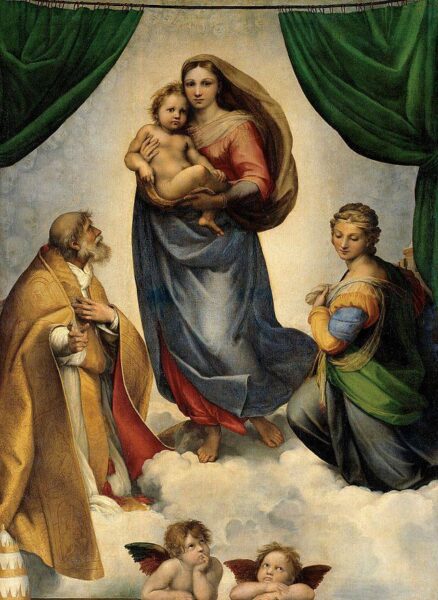
The enormous painting (265×196 cm) was created by Raphael (1483-1520) for the altar of the Church of St. Sixtus. There is a hypothesis that the picture was written in honor of the victory over the French who invaded Italy. Pushed to the sides, green curtains reveal to the viewer Madonna, who is walking on wide clouds with a baby. The light clouds in the background, which form a kind of glow around the Madonna, consist of many small angel heads. To the left of the Mother of God, we see St. Sixtus, a martyr and Pope who lived in the 3rd century. His papal status is indicated by the tiara placed below.
Addressing the Mother of God, St. Sixtus points, it seems, to the believers in front of the painting, presenting them to the grace of the Madonna. At the same time, we mention that the painting is actually intended for the altar of the church, and not for a museum exhibition. On the right, near the edge of the picture, is Saint Barbara, a martyr who also lived in the 3rd century. Because of her indescribable beauty, she was locked in a tower marked by her shoulder, and later, when her father found out about his daughter’s conversion to Christianity, he beheaded her.
The parapet, on which the two angels lean, is pushed forward as a boundary between the audience and the heavenly scene, emphasizing once again the distance between the real and the supernatural realms.
There is a theory according to which the painting was originally intended for the tombstone of Julius II. This is indicated by a small detail – an acorn above the Pope’s tiara. Since Pope Julius II came from the della Rovere family, whose coat of arms featured an acorn, this theory is plausible. According to this theory, the parapet depicted below should mark the sarcophagus of the pope, while the gestures of the saints in this case indicate the dead pope.
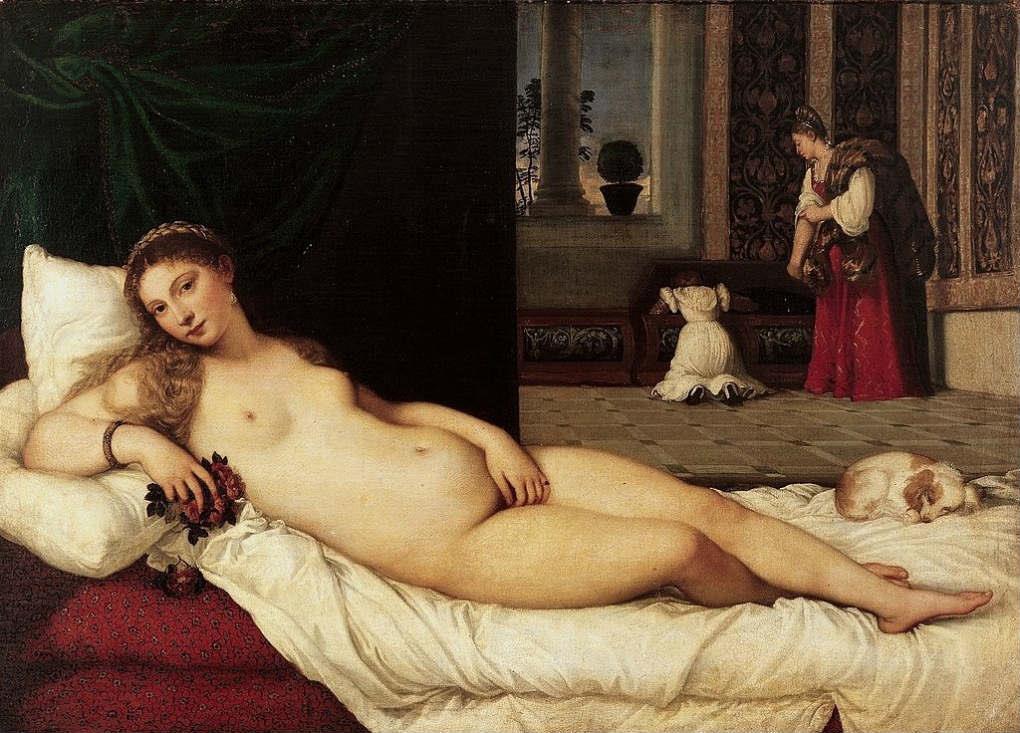
There is no excess of beauty and love, so we mention another iconic Venus from the Renaissance. This painting was purchased by Guidobaldo della Rovere, Duke of Urbino – it was from him that the painting got its current name. The Venus of Urbino is the embodiment of all the characteristic features of Titian’s painting. In particular, hair, skin, fur, flowers, fabrics and precious stones are rendered by the artist with a naturalness close to optical illusion. With this aesthetic device, as well as the sfumato surrounding the woman’s body, Titian demonstrates a high level of artistic skill. This magical word – sfumato – describes a technique in which the contours of objects on the painting are blurred. It conveys the optical effect that we observe in real life when someone approaches us from afar. Air flows around the body – and the contours soften. This is sfumato. If you are interested in painting techniques that were common among artists at different times, we offer you to order our art history lectures. This painting echoes Giorgione’s «The Sleeping Venus» – take a look:
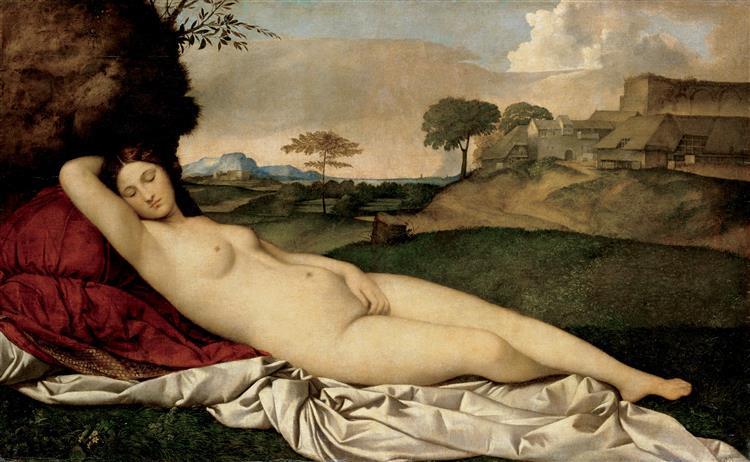
The body of women in both paintings – both by Titian and Giorgione – reflects the ideal of beauty and is a kind of erotic symbol of The Late Renaissance. A high forehead, which was considered beautiful in the Middle Ages and for which women pulled out the hair on their foreheads, has ceased to be ideal. Now the face was beautiful if framed by hair. The favorite hair color was not dark, as in most Italian women by nature, but light. Almost all mythological figures depicted by the High Renaissance artists had blond hair. Breasts were considered beautiful if they were small, round and elastic. Titian chose a room where everything breathes the coziness of a house: in the background, a maid is looking for something in a chest, and another is looking at her expectantly. There is a myrtle on the window – a symbol of married life, white sheets are spread on the bed and white pillows are thrown – they speak of the purity of a woman at whose feet a dog curled up. This dog symbolizes devotion.
There are two versions of the interpretation of Titian’s beauty, which contradict each other. According to one of them, the picture symbolizes the bonds of marriage. At the same time, the chest with clothes in the background is considered as a dowry of a naked girl. Other researchers believe that «The Venus of Urbino» is a portrait of a courtesan who seems to offer herself to the viewer.
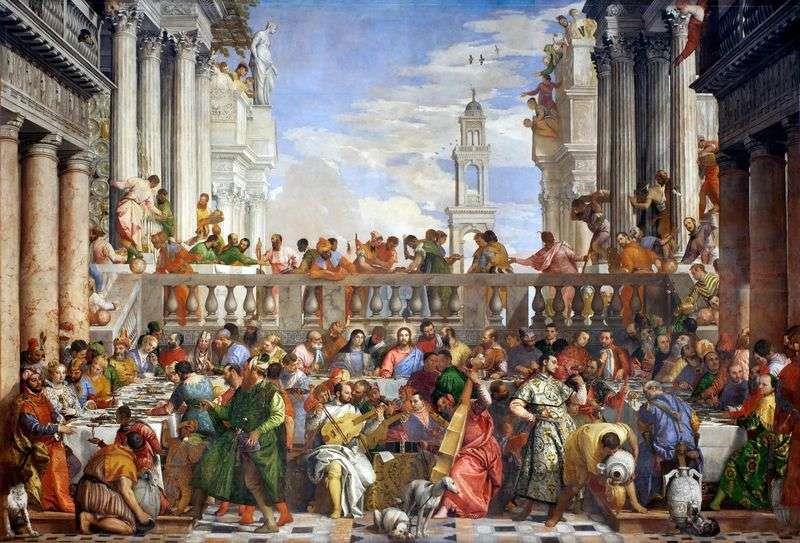
«The Wedding at Cana», also known as «The Wedding Feast at Cana», is a work by Paolo Veronese (1528-1588) depicting the biblical story of the wedding feast described in the Gospel of John, where Jesus turned water into wine. This was the first miracle that Jesus performed at the beginning of his ministry, so this plot is common in art. The large-format painting (6.77m x 9.94m) is made in the style of the High Renaissance and is the widest painting in the Louvre museum. The stylistic influence and harmony of such artists as Leonardo, Raphael and Michelangelo can be felt in this artwork. While High Renaissance art strives for ideal proportions and beauty, Mannerism exaggerates these ideas, adding to them unnaturally elegant, asymmetrical compositions filled with tension and instability. In «The Wedding at Cana», Veronese used many technical techniques, showing intelligence and sophistication.
The background of the painting is a mixture of architectural details from Antiquity and the Renaissance. Columns, low balustrades and towers behind are combined in one composition. It is worth noting that the group of musicians in the foreground is playing instruments of the late Renaissance – by no means the period of the beginning of our era in Israel.
Among the numerous figures, and there are about 130 of them in the picture, you can find such historical figures as Suleiman the Magnificent, Emperor Charles V, Daniele Barbaro (architect and writer), Marcantonio Barbaro (diplomat) and many others. The author also included his self-portrait and images of the artists Jacopo Bassano, Tintoretto and Titian. And of course, the painting depicts biblical personalities.
The lower part of the painting is dominated by Greco-Roman architecture. We can see popular characters of that time and historical figures invited to a biblical meal. Here we also see Jesus. This is the only character that looks directly at the viewer.
There is a hidden symbolism in the painting that shows the emptiness of human vanity. It manifests itself in an hourglass on the vertical axis with respect to Jesus.
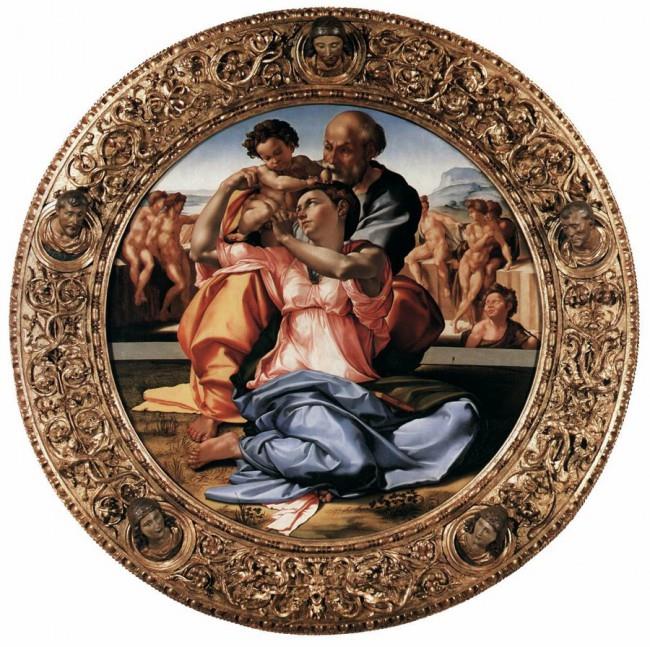
«The Doni Tondo» is the only finished panel painting by Michelangelo that was created not on a wall. Agnolo Doni is a Florentine weaver who commissioned a painting for his wedding. It depicts the Holy Family (baby Jesus, Mary, Joseph). Their figures seem to be intertwined. A woman’s hand rested on Joseph’s knee, the baby’s fingers caught in his mother’s hair. In a strange and unnatural way, Joseph hands the baby to Mary, who is sitting on the ground. There is an opinion that the painter «played» the name of the customer in this pose (from the Italian «donare» – to donate, «doni» – gifts).
The multi-layered manner of writing was developed by the artist as one of the versions of the sfumato painting technique – do you remember the meaning of the word? But here the image takes on depth and perspective not because of maximum smoothing of transitions, but due to color contrast. This is how the work on the image of the Holy Family predicted the technique that Michelangelo would use during painting on the ceiling of the Sistine Chapel.
The group of people in the foreground is highlighted not only by color. The folds of the drapery are sharply modeled, they appear frozen, and therefore look less like fabrics than like sculptures set in stone. A lot of mysteries accompany this painting. And to this day, the meaning of the naked young men located in the background is not clear. There are several versions, often completely opposite: some consider them figures of angels, others – a symbol of the pagan worldview. Some of the young people depicted in the background of the picture are leaning on a stone, some are sitting on them. The outlines of the stones may be related to the lunar crescent, present in the form of the family coat of arms on the cloak of Maddalena Strozzi, Agnolo Doni’s wife.
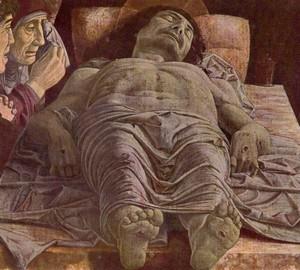
Andrea Mantegna (1431-1506) refers to the well-known plot «The Lamentation of Christ», depicting in an unusual angle the body of Christ and three people who mourn him – the mother of Jesus Christ, Mary Magdalene and the apostle John. Christ is lying on a marble bed and is located in the center of the painting. His head is slightly tilted to the left and rests on a pillow. Christ’s legs are covered by a cape, but his chest, hands and feet remain bare. On the hands and feet are depicted the stigmata of Jesus, which remained from the nails with which he was nailed to the cross. Characters mourning Christ are located on the left side of the painting. The painter showed only part of their faces, focusing attention on the figure of Jesus. Thanks to the unusual perspective and somewhat exaggerated perspective reduction, Mantegna was able to depict all the stigmata of Christ. As you know, this painting was very valuable to the artist himself and was kept in his house until his death. There are assumptions that the painting that has survived to our time is a copy, and the original has been lost.
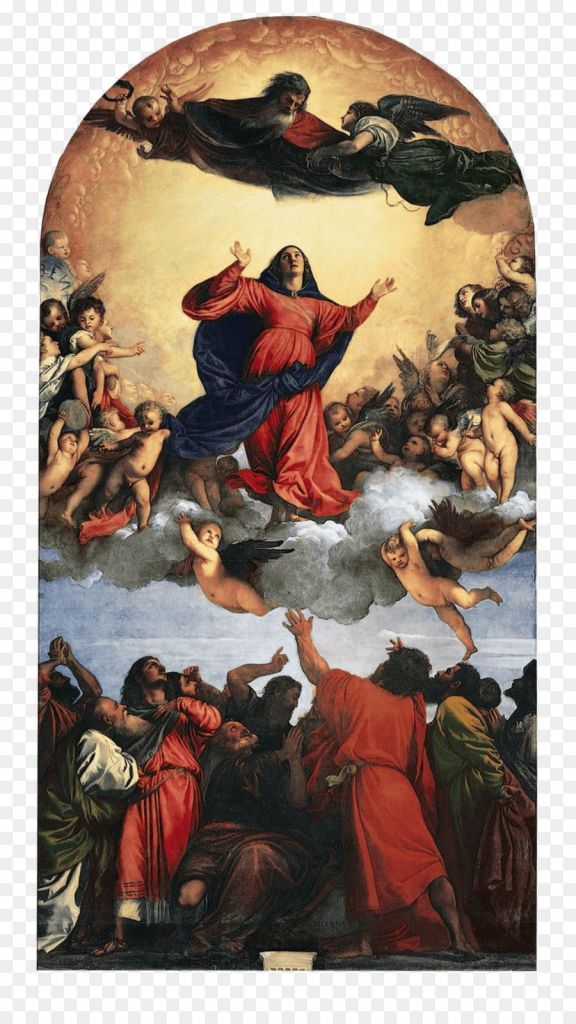
This painting should not be looked for in a museum, but in the place for which it was intended – in the Frari church in Venice. The painting «Assumption of the Virgin» was Titian’s first major order in Venice, where he later became a famous artist. Note that we are only talking about the middle part of the triptych – it was Titian who painted it, and the two side parts were painted by Palma Vecchio (1480-1528). The events in the painting take place on three different levels. At the lowest level are the apostles, frozen in various poses. They look at the sky with fear, as if they are praying with outstretched hands. In the center of the composition is the Virgin Mary in red clothes with a mantle. The Virgin Mary is shown shortly after her death as she ascends to heaven, where God is waiting for her and preparing a crown for her. The plot is based on the biblical story that the apostles gathered in Jerusalem to bury the body of the Virgin Mary, but witnessed her ascension to the Kingdom of Heaven.
Titian broke with tradition by omitting all landscape elements, although the gray-blue sky above the apostles shows that the action takes place outdoors. The sky contrasts with the golden celestial light in the upper zones, reminiscent of the gold background traditional for the mosaics still made in San Marco, and of the gold frescoes of the Gothic period.
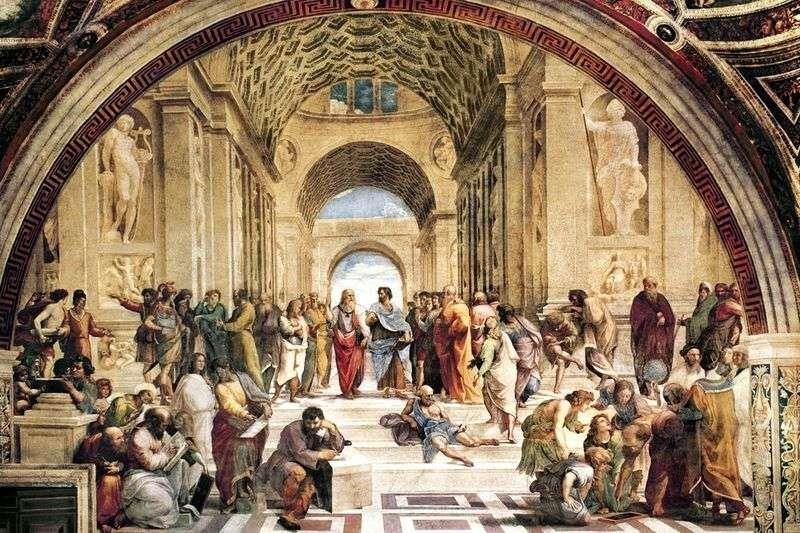
The fresco «School of Athens» is an example of the author’s formed style, which was formed under the influence of his uncle, the famous architect Donato Bramante. The action on the fresco unfolds against the background of a huge marble temple. But this temple of ancient wisdom is empty. In search of truth, philosophers leave it. They seem to be divided into several groups. Immersed in the dispute, Plato and Aristotle are the last to come out. Philosophers cluster around Aristotle and Plato and talk to each other. It is interesting that the author gave Plato similarities with Leonardo da Vinci. At the foot of the stairs, the two most numerous groups of philosophers are arguing: on the right, a group of young men surrounded Euclid, whose appearance bears a resemblance to the architect Bramante. Ptolemy is also located here, followed by two boys; Raphael himself is recognized in the image of one of them; on the left – the philosopher Averroes (Ibn Rushd). Pay attention to the boy who is sitting and writing something down. This is an ordinary scribe. It would seem that he is so unimportant in this picture that we are not even shown his face. But if you look closely at his hair, it is blown out in a way that is different from the hair of other characters. In Rafael Santi’s perception, the absence of wind is the absence of time movement. All the characters of this picture remained in history. And with this scribe everything is the opposite: he succumbs to the movement of time, his hair is blown by the wind precisely because he is the one and only character who will write down all the words of these great people and thereby make them eternal.
If you are interested in mysteries, you are thirsty for discoveries and new skills, we are ready to share the secrets of art with you. We promise to do this at our master classes. And you will definitely find one more favorite place where to go in Kyiv. Our visitors recommend.
Make your loved ones happy – order a gift certificate for master classes or lectures of the Lihtaryk art studio.
In addition to offline classes, we have prepared for you interesting online master classes and lectures, which you can also order on our website.
У меня синдром Стендаля сегодня. Утром ходили в Падуанский баптистерий. Смотрели фрески Менабуя. А после обеда у нас было посещение каппелы Скровеньи. Теперь я понимаю , что сделал Джотто для мира. Очень меня все это впечатлило в живую. Привет передала. Мир прекрасен. Падуя очень понравилась:) спасибо за лекции Света!
Lily Golovchak
Our location


