
Art is usually something beautiful and high in the imagination of people. But art is also detective stories of the creation and movement of paintings or other works; this means big money and big ambitions. Therefore, get acquainted with three famous detective stories in the field of art.
The history of the altar, almost 4 meters high, began in 1432 in the Belgian city of Ghent. It consists of 12 panels and was painted by one of the most famous artists in history – Jan van Eyck. Although the secrets of this altar has already begun here with the following inscription: «The artist Hubert van Eyck, better than whom there is no one, began, and his brother Jan, the second in art, completed the great work at the request of Jodocus Vijd. May 6, 1432». The mystery is that there is no evidence about Hubert and it is still not known for sure whether he really existed.
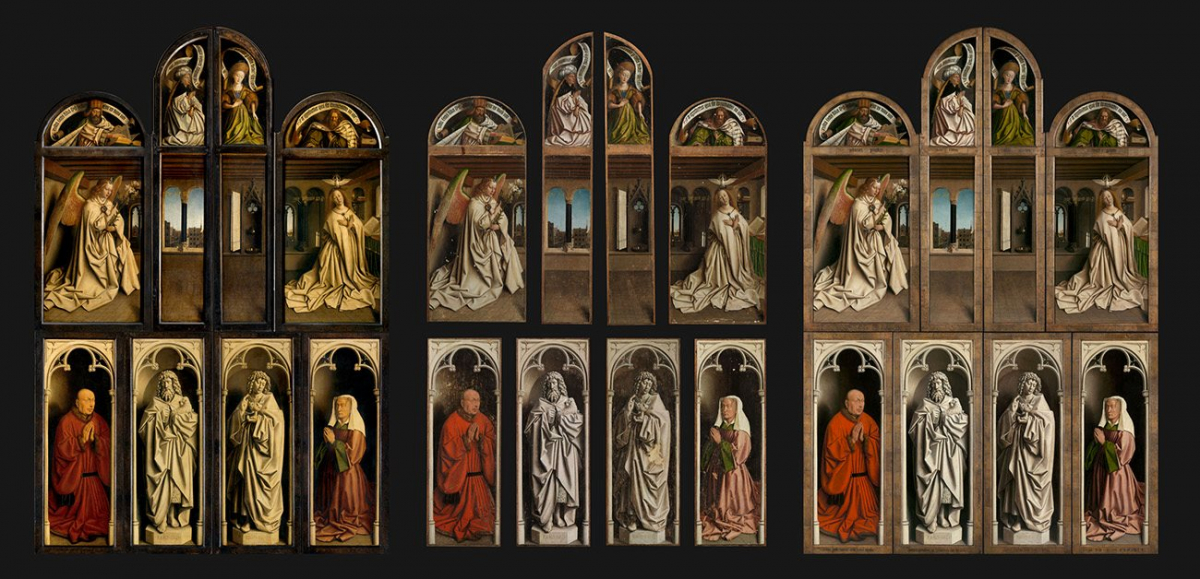
The Ghent altarpiece was a kind of avant-garde of the 15th century. What now seems to us «classical art» was absolutely revolutionary. Starting from the interpretation of the foundations of the Christian faith as more humane to depicting our world in all its glory. It should be mentioned here that for a person of that time, the earthly world was primarily sinful! The Ghent Altarpiece shows a beautiful world. You just have to look closely at the nature that the artist depicts: every blade of grass, every flower is depicted in all its glory.
Another revolutionary feature of this painting was its realistic depiction of the human body. It is believed that Adam was painted from life for the first time north of the Alps. In Italy, processes of revival of ancient traditions in the depiction of the human body took place. After all, the Italians had such a tradition since Roman times, but Flanders had no such tradition.
During the Reformation, the Ghent Altarpiece became a symbol of the Catholics of Northern Europe, which meant that Protestants tried in every possible way to destroy it. Times were turbulent and many works of art were destroyed due to religious views.
In addition to its religious significance, the altar also had political symbolism due to its location: St. Bavo`s Cathedral in Ghent. The future Emperor of the Holy Roman Empire and, at the same time, the hated King of Spain in the north, Charles V of Habsburg, were baptized here.
During the Calvinist uprising in August 1566, the altar was saved by believers who placed a colleague with a barrel of beer in front of the door where the relic was hidden. It must be said that the trick worked and the intoxicating drink distracted the Calvinists from searching for the altar.
The next Calvinist attack on the altar occurred 12 years later. Then he was saved by the Calvinists themselves, who decided to use it to pay off Queen Elizabeth of England for a loan to fight the Spaniards. However, the Vijd family, who ordered the altar, paid the ransom and saved it.
In 1794, the altar could no longer be saved from Napoleon. Bonaparte dreamed of creating the largest collection of art and founded a museum. It was in the Louvre that Napoleon collected artifacts from all his conquests.
Part of the altar went to the Louvre, where Napoleon collected all his trophies. However, the Battle of Waterloo and Napoleon’s defeat helped Ghent bring home the stolen panels.
And that is not all. In 1816, the vicar of the cathedral sold the side panels, ostensibly to repair the cathedral. Let’s be honest, we wouldn’t believe such a version of a careless clergyman either. But it was too late, the panels ended up in Berlin.
When the First World War began, the dismantled panels of the altar were removed from the cathedral by a canon under the guise of a rag-picker. He successfully hid his treasure. And after the Germans lost the war, part of the altar, which had been in Berlin for almost a century, returned to Ghent. The reunion of the cathedral was a real national holiday.
And 14 years later, in 1934, some of the panels that returned from Berlin disappeared without a trace. The authorities suspected the Germans, who were already actively forming a new misanthropic ideology. But this time the Germans had nothing to do with it.
But with the arrival of Hitler, the altar was taken to Neuschwanstein Castle in Bavaria. As you know, the Fuhrer dreamed of creating the largest museum in the world (another fan who was obsessed with art). The failed artist in his head was making itself felt. It was only after World War II and a breathtaking rescue operation that the altar returned home to Ghent.
Mona Lisa or Gioconda is, without exaggeration, the most famous painting in the world. And it gained its world fame not only thanks to its author or the uniqueness of the portrait. Mona Lisa owes her incredible popularity to the story of her abduction and return to the Louvre. But let’s start this story from the beginning.
Leonardo da Vinci painted a portrait of who is believed to be the wife of a Florentine merchant named Giocondo. But, like many of his other works, Leonardo could not finish the portrait and took it with him to France. The Italian artist was invited to Paris by the French king Francis I as an organizer of the holidays. After Leonardo’s death, Mona Lisa ends up in the collection of the French king and is exhibited in the Louvre. True, over time the picture becomes outdated and loses its appeal. And the Louvre itself also temporarily lost its high status. There was a time when the first floor of the Louvre was rented out as craft workshops.

And all this time, the Italians dreamed of returning Gioconda to Italy. At the time of 1911, the Mona Lisa in the Louvre was not the most famous painting. One day, one of the museum workers, an Italian by birth, in broad daylight removes the painting from the exhibition and takes it away, as if for restoration. No one stops him, even when he takes the painting out of the museum. Vincenzo Perugia thus commits the robbery of the century. When the painting’s disappearance is noticed, the museum contacts the press, claiming that a valuable painting from the museum has been stolen. And probably it would never have been found if Vincenzo Perugia had not brought it to the Uffizi Gallery in Florence so that she could return home. The director of the Uffizi immediately reported the discovery, and the entire world press again wrote about the incredible find.
And then the story of the world fame of Gioconda began. The Louvre Museum decided to make a world tour of one painting. The painting traveled to the USA, where it attracted so many people who wanted to see it that the organizers were forced to limit the time spent contemplating the painting. And in Japan, people did not have the opportunity to stop in front of the painting and simply walked past in a line. There were so many people who wanted to see the legendary picture. And upon returning the painting to the Louvre, the museum declared that it would never leave its walls again. This led to the incredible popularity of the painting and a genuine pilgrimage to the Louvre.
The most famous painting by Rembrandt and the hallmark of the Rijksmuseum in Amsterdam, «The Night Watch», is not at all night. And this is just the tip of the secrets of this picture. The real title of the painting is «The company of Captain Frans Banning Cocq and Lieutenant Willem van Ruytenburch» and it received the name «Night Watch» because of its dark coloring. The painting darkened over time, perhaps due to experiments with pigments that the artist did.
These kinds of group portraits were very popular in the 17th century. Each of the characters in the picture paid money, and the price changed depending on where exactly in the picture a particular character was depicted. 90 representatives of the rifle company were also depicted here. But the size of the painting was so impressive that it did not fit into the frame and the workers decided to simply cut off part of the painting. A full 60 cm on the left was simply cut off along with two figures, smaller strips were cut off from the bottom and right of the picture.

According to one of the most common versions of Rembrandt’s career, it was exactly that painting that caused its collapse. It seems that the customers did not like that Rembrandt depicted them according to his vision of the composition, and not according to the fees paid. In addition, in the center of the picture there is a girl, whose appearance is still a mystery to researchers. She looks like the artist’s first wife, Saskia. But what is she doing next to the rifle company?
You can learn more about works of art and some related stories in lectures on the history of European art in the art studio «Lihtaryk».
У меня синдром Стендаля сегодня. Утром ходили в Падуанский баптистерий. Смотрели фрески Менабуя. А после обеда у нас было посещение каппелы Скровеньи. Теперь я понимаю , что сделал Джотто для мира. Очень меня все это впечатлило в живую. Привет передала. Мир прекрасен. Падуя очень понравилась:) спасибо за лекции Света!
Lily Golovchak
Our location


