
Andy Warhol (Andrew Warhola) was an American artist of Lemko origin (ethnographic region in the Carpathian Mountains and foothills that spanning Ukraine, Slovakia and Poland).
Extraordinary is the most laconic epithet that can be chosen for Andy Warhol’s name. This man never hid that art for him is a business. But for some reason, this did not upset anyone at all – everyone just wanted more to get the work of his authorship. And to this day, he is perceived as one of the most successful artists of the 20th century.
At the peak of his career, having conducted thousands (no exaggeration) of experiments with creative methods, earning a colossal amount from his work, Mr. Warhol will publish the book «The Philosophy of Andy Warhol», in which he will note: «Being a good businessman is the most amazing form of art. Making money is an art, working is an art, and good business is the best art». What prompted him to increase his wealth so much?
Little Andy had a hard-working father, a caring mother and two older brothers. The middle-income family tried to spread the funds as practically as possible – so Andy knew what it was like to wear second hand belongings of his older brothers. Seeing how his father worked late at the factory, realizing that some people lived in luxury and he did not, the boy asked himself the question: why is life unfair? Little Andy felt that he was no worse than other people – richer, more successful – besides, he definitely knew that in addition to his sense of self-worth, he had something else – a talent for painting.
One day he was sitting at home doing his favorite hobby – cutting out photos from old magazines and making collages out of them – and his mother asked him what he was doing. Andy replied that he was portraying his desires. In the collage, surprisingly, there were no children’s appliqués at all – everything was too practical and adult: an expensive car and a house, and Andy was in the center.
– Do you want an expensive car and a big house? – asked the mother.
– No, I want to live in this world and become the main one in it.
When you learn about Andy Warhol, you involuntarily bow to parents like his. From a boy from an ordinary family, he grew into a giant of spirit – free in his judgments, bold in his ideas. His parents were able to develop confidence and self-belief in him – necessary traits for life. They gave him a feeling of support and were understanding, because the father knew about the talent of his little Andy, so he began to save money for his son’s education in advance. And most importantly, his parents did not force Andy to choose a «practical serious craft», instead they gave the boy freedom – and their son graduated from the design department, a diploma from which became his ticket to the art world. Incidentally, we note that Andy could inherit a bold and even adventurous spirit from his parents – they moved to the USA at the beginning of the 20th century from Lemkivshchyna. And Andy Warhol himself was baptized as Andrew Warhola at birth. Andrew picked up a new fashionable name only when he moved to «The Big Apple».
This move took place immediately after graduation. With a degree in design and a few friends by his side, Andy moves to New York with the clear goal of becoming famous. Fortunately, everything goes according to plan – Andy gets a job as an illustrator. His first order was an illustration for the article «Success is a job in New York»
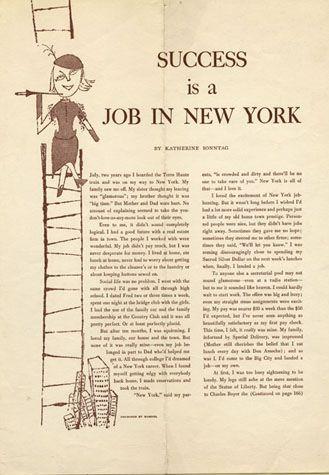
In this and other illustrations at the beginning of his artistic journey, he used a technique that he developed during his college days. Its essence is a combination of a drawing and an estampe (printmaking).
Let’s put everything on the shelves. First of all, Andy prepared several sheets of paper before starting work. On one of them – the kind that slowly absorbs paint – he painted an image. Then he applied another sheet to this sheet – already one that absorbs paint quickly – and voila! A print appeared on the second sheet – almost a print and almost a drawing. This second sheet of paper with an imprinted pattern was created with seemingly broken lines, seemingly carelessly, but at the same time innovative and stylish. If you look closely at the illustration above, you will definitely see the fragmented structure of the image. These broken lines became not just his feature, but also a smart approach to work – so it was possible to create two images with slightly different strokes at once. These images, moreover, can be colored in different ways, so the customer will be able to choose an illustration to his taste from among more options, and Andy will do less work. In general, the idea of automating his work will motivate Mr. Warhol to innovative experiments, which will earn him the fame of a true innovator.
Warhol was an entrepreneur. He began his career in the 1950`s as a commercial illustrator, earning a substantial income to finance his artistic endeavors. A significant share of orders came from the footwear company «Miller Shoes», for which Warhol regularly created advertising images:
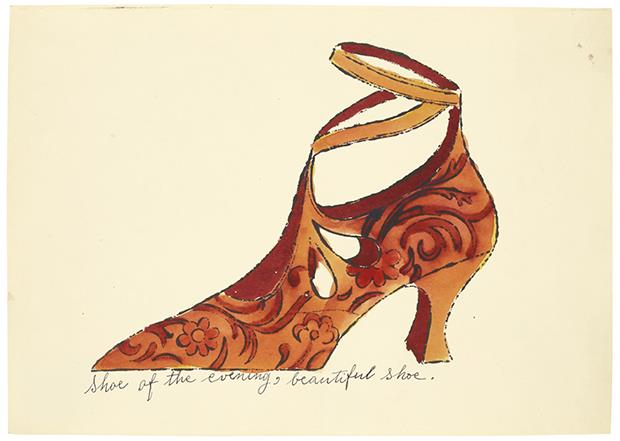
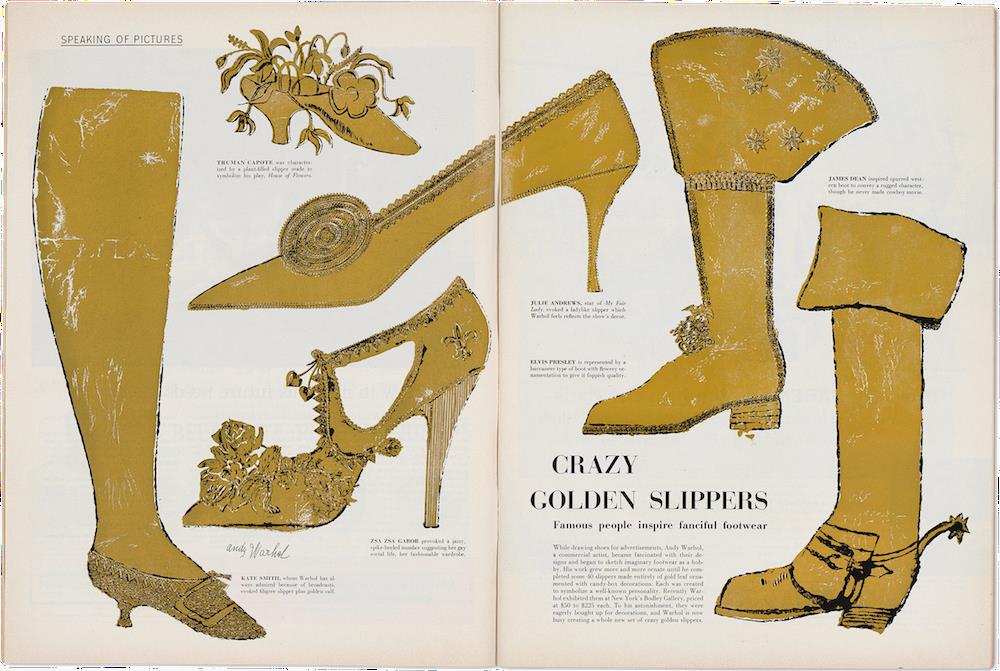
At this time, Mr. Warhol often used gilding to decorate his images. Art historians claim that the gilding in the illustrations became an echo of his childhood experience – as a small boy, Andy often visited the church with his parents, where he absorbed the beauty of the richly decorated iconostasis.
So Warhol got rich in the great and promising New York. He was given more orders for illustration, which is certainly not bad, but the young ambitious artist never wanted to be just an illustrator. Do you remember? «…to live in this world and be the main one in it». So already in the mid-1950`s, Andy participated in art exhibitions. Of course, there were not many favorable reviews, but Warhol knew that his kindred work is art, so he continued to search for himself. In this search, he paid attention to a new fashion direction in which several artists have already started working – this direction became the famous pop art. Growing up during the rise of post-war consumer culture in the US and England, Warhol understood the benefits of assembly lines in manufacturing. Striving to automate his work, he used any auxiliary means – among them were both equipment and living people – his studio assistants. Any innovations that could turn an art object into a production product, Warhol liked to use in his work. He was in the cohort of those artists who discredited art as a spiritual activity and turned it into production.
We are already beginning to detect notes of discontent in your thoughts. But let’s wait and try to understand why the commercialization of artistic activity is not such a bad idea as it appears at first glance. The fact is that Warhol did not just turn art into a product, he successfully balanced commerce, philosophy and avant-garde. Throughout his career, he had constantly tried to experiment in new media – publishing, film, music production, television, fashion, theater – and had often collaborated with artists and brands. How did he get there?
It all started with a bottle of cola. In 1962, Warhol created her image:
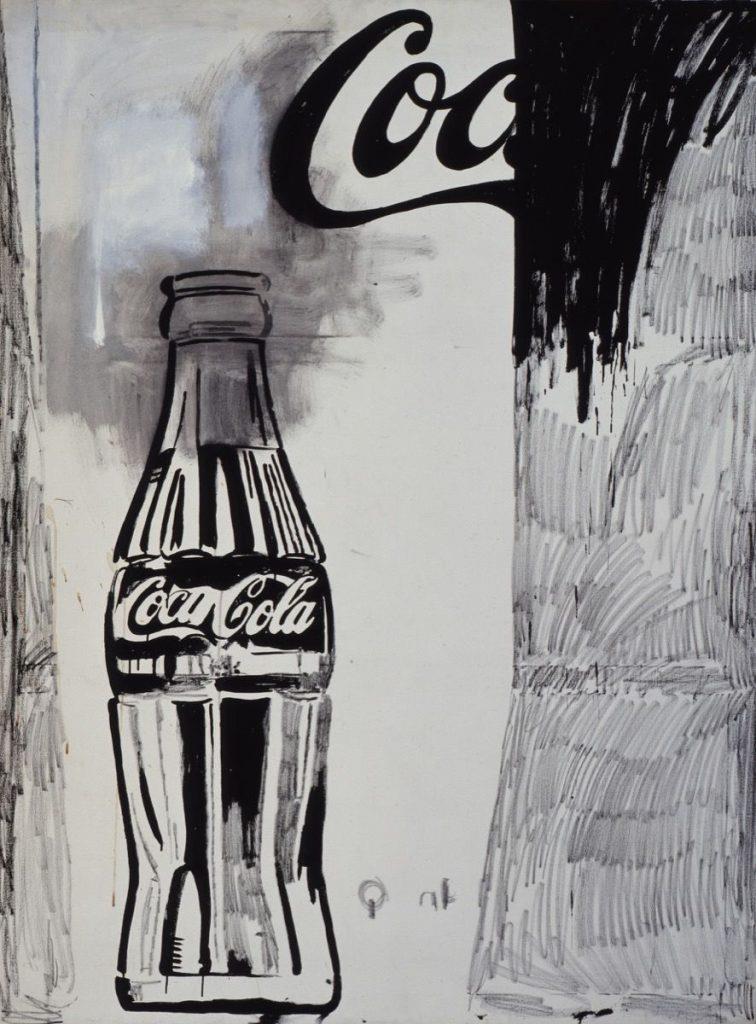
This image is confusing, but it formed the basis of Andy Warhol’s work. The essence of the image is best demonstrated by lines from the artist’s book:
«You watch TV and you see Coke; and you know the president drinks coke, Liz Taylor drinks coke and just imagine, you can drink coke too! It really fits the American idea of equality».
And Warhol depicted hundreds of such household items that unite thousands of Americans. At one of the exhibitions in the 60’s – it was at this time when Warhol turned from an illustrator into a pop artist – he presented paintings in such a way that they resembled shelves in a supermarket. This was a logical step, since the paintings themselves depicted cola, hamburgers, and banknotes. Such art objects clearly outlined the idols that ruled the people in the post-war period. Money and things. Things and money again. Before Warhol, no one tackled such simple subjects of the image. Before Warhol, no one showed our consumerism as a philosophy that drives billions of people around the world.
In addition to Coca-Cola, fast food and money, soup from «Campbell» was also honored to participate in the exhibition. This product has been consistently sold from supermarket shelves for decades. It was eaten so often that no one thought about what an important part of life this product has become. And the artist drew 32 cans of this soup. Out of 32 images, he executed only one with oil paints – the rest were created using the technique of silk printing – one of the types of color printing. Pictures of soup were stacked one on top of the other – as if on a store shelf – and each picture represented a different taste. The most interesting thing is that people did not just watch at the young artist’s exhibition, they even bought some paintings, which shows acceptance and interest. Obviously, such art responded to the demands of society. Several «cans of soup» were sold directly at the exhibition. However, at the last moment, Warhol and his assistant changed their mind – they decided that these paintings should not be sold, but combined into one. Thus, a complete series of «32 cans of Campbell’s soups» was preserved.
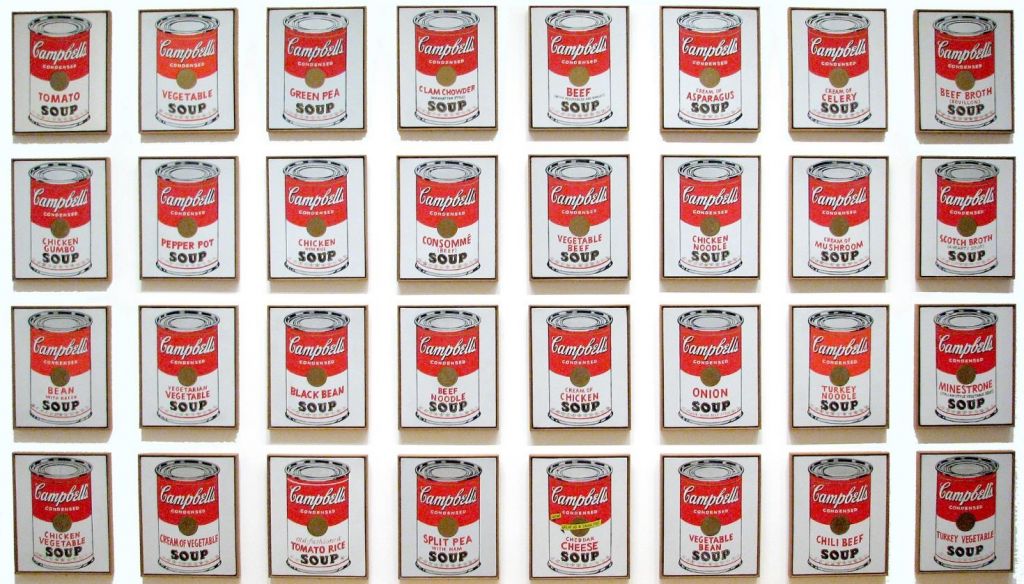
Please note that 31 images of cans were printed and not painted. Automation of work, constant reprinting is what can be considered one of the distinctive features of Warhol`s work. And this is also the reason why it was so easy for him to return to old works and present them to the public again after a certain period of time. While printing, he had the opportunity to constantly experiment with already finished works and create new variations. So don’t be surprised when Google turns up dozens of images when you search for «Marilyn Monroe Warhol». Here is one of the series of portraits of Monroe created by the artist in the 60`s:
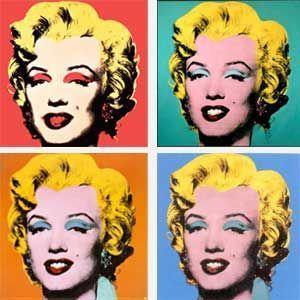
Mr. Warhol did not choose printed images of Marilyn Monroe by chance – she had become an integral part of pop culture and its most famous representative. After her death, she became an idol, so the personality of Marilyn Monroe was an ideal object for Warhol’s work. In addition to Monroe, Warhol created reprints with Elvis Presley and Elizabeth Taylor – other famous idols. Considering that society idealized these people and sought to imitate them, Andy made a good decision to turn their portraits into salable postcards and paintings. As a representative of consumerist society and an artist, Andy Warhol caught trends and vividly reflected them in his work.
But he did not limit himself to printing – the artist is also known as a director. His films belong to the underground, since there was practically no plot in them. In order to better understand what Warhol was filming, we will point out just one fact – in the first film with the mysterious name «Sleep» (1963), he filmed a sleeping man. The tape was made without editing, so the viewer could watch the sleeping naked poet John Giorno for five hours and twenty-one minutes. Warhol had many such film tests, they differed in subject matter, but every one of them was a non-format and a parable among recognized directors. However, thanks to some of these films, young actors started their careers. Cooperation with Mr. Warhol became a springboard for them to success, because they were noticed by other directors – and Andy liked it.
Only one of the films made by Warhol became commercially successful – it was «Chelsea Girls» (1964):

Andy’s quick approach to work, his non-standard and bold thinking encouraged customers to cooperate with him again, and extraordinary personalities to gather around him. Usually, young artists, stars and just friends came to Warhol`s Silver Factory, where they could afford everything – to relax, fool around, and even star in Warhol`s film or assist him in the process. Many of the art products at the factory were created by assistants under the leadership of Warhol – for him, collective creativity was not an encroachment on the status of an artist, but rather one of the ways of working. Moreover, Warhol was not shy to look for ideas, consulting with acquaintances. He liked to listen to advice about what would be relevant to depict. He did not adopt all the ideas, of course, but he implemented some of them into reality – his close associates, as we can see, were both his inspirers and associates.
Openness to ideas allowed Warhol to try himself in various activities, in particular, designing records for musicians – «The Rolling Stones», for example, he was commissioned to design the cover for the album «Sticky fingers». And the desire to be constantly present among the beau monde prompted him to film his own shows, such as «Andy Warhol’s TV» and «Andy Warhol’s Fifteen Minutes». The latter was clearly in line with his goal of letting everyone have their 15 minutes of fame.
At the end of his life, Andy bequeathed all his funds to support young artists, which confirms his desire to create favorable conditions for the development of his young colleagues. After all, in retrospect, it becomes clear that this artist did manage to «become the main» in his field. The dreams of young Andriy came true in the real life of adult Andy.
We share Andy Warhol’s goal and encourage the discovery of talent. For your attention – a wide range of master classes, where you can try various techniques and express your philosophy through creativity. We do not limit the imagination of our guests – we only help it to turn into a work of art. In addition, art history lectures are available to you, where you can learn more about artists and their work. You can also buy a gift certificate at our studio and visit us as a part of your leisure activities.
У меня синдром Стендаля сегодня. Утром ходили в Падуанский баптистерий. Смотрели фрески Менабуя. А после обеда у нас было посещение каппелы Скровеньи. Теперь я понимаю , что сделал Джотто для мира. Очень меня все это впечатлило в живую. Привет передала. Мир прекрасен. Падуя очень понравилась:) спасибо за лекции Света!
Lily Golovchak
Our location


