

Головна > Botanical illustration > Botanical illustration

Botanical illustration is the art of depicting the shape, color, and details of a plant. This is an artistic genre in which both scientific accuracy and skillful picturesque execution are combined. In the 16th century, botanical illustration was mainly used for scientific purposes, for better recognition of plant species. Now it is gaining popularity again and is more related to design than science.
Botanical illustration is one of the most popular types of illustration. Despite its long history, botanical drawings still attract more and more supporters of this technique with their simplicity, accuracy and beauty. However, what we now perceive as something quite mundane began with a purely scientific purpose. The main task of botanical illustration was to give an accurate representation of plants that may or may not be used for medicinal purposes.
The botanical illustration of plants aimed to create a kind of catalog, like an encyclopedia of the plant in the world. In 77 A.D., the Roman physician Dioscorides wrote and illustrated the book «Materials of Medicine». This book of botanical illustration has been the main source for understanding the plants of the world for almost 1,500 years. Botanical illustrations of flowers were redrawn from it, and the description was supplemented and rewritten in medieval scriptoriums from century to century.
With the invention of the printing press by Gutenberg, botanical illustration appears in graphics. Engravers transfer drawings to books and they become quite widespread. With the discovery of new continents, the study of botany gives new impetus to botanical illustration.
Albrecht Dürer is considered the most famous artist who created botanical illustrations. He was almost the first to bring botanical images of plants to such a high level. His watercolors are still kept in the Albertina in Vienna and form the heart of the museum’s collection of Dürer graphics.
In the 17th century, an outstanding artist, the author of botanical illustrations not only for books, but also for clothes, textiles and other household items – Maria Sibylla Merian. The artist studied flowers for botanical illustrations with special attention and detail. She developed water-resistant paints that made it possible to paint tablecloths. It was really a new word in decorative and applied art. In addition to depicting flowers, Maria Sibylla perfectly combined botanical illustration with drawings of insects, fruits and rare animals. By the way, the artist even made a trip to Suriname. Just imagine – a woman in the 17th century goes on a scientific expedition to a distant country to study rare plants and insects.
Before the advent of photography, «botanical illustration» was more of a scientific activity. And from the end of the 19th to the beginning of the 20th century, the emphasis shifted to design.
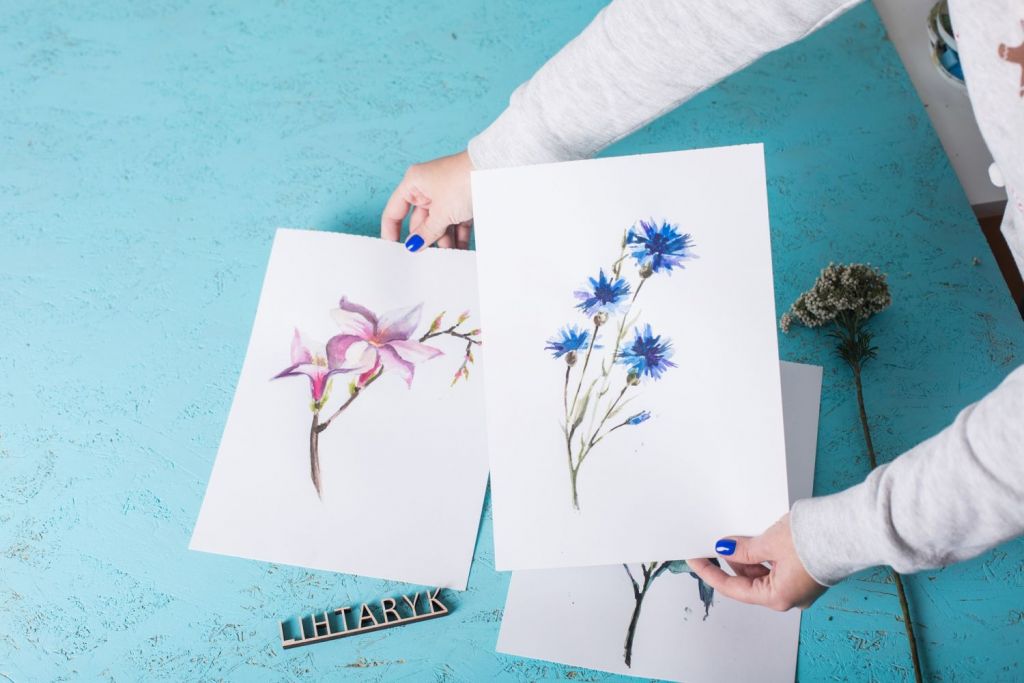
Modern botanical illustration can be done in a variety of techniques. The botanical pencil illustration is more graphic in nature. The watercolor botanical illustration looks very light and delicate. We use watercolor as the main technique for botanical illustration in our workshops.
Georgia O’Keeffe should be singled out among the best artists who developed the botanical theme in the 20th century. She painted flowers with oil paints on large canvases and look on them as like under a microscope. O’Keeffe’s flowers are not just botanical drawings. This is a kind of anatomy of a flower, often filled with erotic connotations.
The most popular modern subjects are botanical illustrations of lavender, poppy, iris, and ragweed. In addition, botanical illustrations of dandelions, peonies, roses, lilacs, phloxes, and nasturtiums are popular.
Watercolor botanical illustrations in the interior look very harmoniously. Decorated in an anti-frame or fragile neutral frame, they fit perfectly into a modern minimalist or Scandinavian interior.
Learning of botanical illustration for beginners is an exciting process not only of drawing, but also of careful contemplation of nature. If you are interested in a botanical illustration, we advise you to carefully observe domestic flowers. In the spring, it is advisable to walk a lot in the parks and look at the trees that are in bloom. This will help you to focus your eye on the right details during creating a botanical illustration. And we will tell you the main secrets and techniques of drawing flowers for botanical illustration at the workshop.
At the workshop of botanical painting, you will be able to:
Our masters will tell you why watercolor paints are most suitable for work in the technique of botanical illustration. You will learn to give the petals softness and smoothness with the help of watercolor pigments. Learn how to get realistic shades for the integrity and harmony of the picture.
You can order a botanical illustration master class by leaving a request on this page or by calling our studio. Botanical illustration is a wonderful creative experience. Make sure of it with us.
Workshops in the «Lihtaryk» art studio are held regularly. Visit us yourself or in a friendly company to reveal and multiply your creative potential!
Plants surround us everywhere. About 80% of prints on clothes are on the topic of botany in one form or another. Floral prints are used in design from wallpaper to postcards, holiday decoration, floristry. The classics of using botanical illustrations are books. So if you want to learn how to draw in this technique, your skills can be in demand in many areas.
However, even if your activity is not related to botanical painting, you will definitely like it, because painting a variety of bright flowers and ripe fruits is really exciting. In addition, it is an opportunity to spend time with friends or loved ones, learn about a new painting technique, dilute the daily routine with an interesting activity.
A botanical illustration can include a general view of a plant, a flower, its anatomy, as well as fruits or seeds, leaves in spring, summer and autumn, trees, bark, etc. This is a composition of one or more types of plants, combined into an aesthetically attractive image. Modern botanical illustration is reduced to a realistic image of a plant, and the final result can be used as a gift or a complement to the interior.
| Name | Botanical illustration |
| Subjects | Painting |
| Form of conduct | Offline |
| Duration | 1.5 hours |
| Master class topic | Drawing shapes, details and colors of different plants |
| The target audience | For adults, for teenagers, for women, for men, family, mixed, corporate |
| Age of participants | From 10 years old |
| Number of participants in the group | Up to 6 people in the studio. There are no restrictions on the client`s location. Private master classes also are available. |
| Materials | Watercolor paper, watercolor paints, brushes |
| Painting size | 20×30 cm |
| Painting drying time | The paintings dry quickly and can be taken home after the master class |
Master classes and workshops at the «Lihtaryk» art studio are held regularly. Come by yourself or with a group friends to reveal and increase your creative potential!




У меня синдром Стендаля сегодня. Утром ходили в Падуанский баптистерий. Смотрели фрески Менабуя. А после обеда у нас было посещение каппелы Скровеньи. Теперь я понимаю , что сделал Джотто для мира. Очень меня все это впечатлило в живую. Привет передала. Мир прекрасен. Падуя очень понравилась:) спасибо за лекции Света!
Lily Golovchak
Our location

